What do mutual fund cash holdings suggest and what does it mean for investors.
The News
The cash pile of mutual funds has gone up by ₹70,081 crores since the start of 2024 and reached ₹1.8 lakh crores.
As a percentage of total Assets Under Management (AUM), cash reserves have increased from 4.36% in December 2023 to 4.98% in November 2024.
💡 Mutual funds keep cash reserves for majorly two reasons: to meet redemption requests without selling investments at unfavorable prices during market fluctuations and to take advantage of new investment opportunities quickly.

Why is it a big deal?
In 2024, so far, mutual funds have deployed ₹4.1 lakh crores in Indian equities, the highest ever in a year. Despite that, mutual funds are sitting on record cash piles.
What does it signify?
The increasing cash holdings of active equity mutual funds indicate a few key trends and possible signals.
1. Fund Managers’ Cautious Approach
Fund managers choose to hold cash instead of investing in the market, majorly because of a lack of attractive investment opportunities.
2. Potential correction
Anticipating potential dips or volatility in markets. Fund managers might prefer to wait and invest at lower valuations and generate better returns for investors.
How does it affect your returns?
Though a fund manager might keep higher cash reserves to grab potential opportunities but keeping cash reserves can lower mutual fund returns because it fetches negligible returns compared to stocks or bonds.
Investors put their money in mutual funds, expecting it to be invested in the markets. If fund managers hold too much cash instead of investing, they risk missing out on market rallies, which could lead to underperformance—something that investors might not appreciate.
How can you check your scheme’s cash holdings?
You can easily find out how much cash your mutual fund scheme is holding by checking the “portfolio” section in the fund details on websites like Economic Times, Value Research, Moneycontrol, or Morningstar.
What’s the ideal range?
While there is no benchmark metric to decide whether a mutual fund’s ‘cash holding as a percent of AUM’ is high or low, as it depends on a fund manager’s assessment and judgment of market conditions and opportunities.
A cash holding of around 5% in an equity mutual fund is normal and required to meet withdrawal requests during volatile markets.
Cash levels such as 8-10% are also not something to worry about, as fund managers might be looking for better investment opportunities or waiting for a correction.
However, with cash holdings of over 10% for a sustained period (2-4 quarters), then one would need to see if the higher level of cash is affecting returns and how peer schemes are doing.
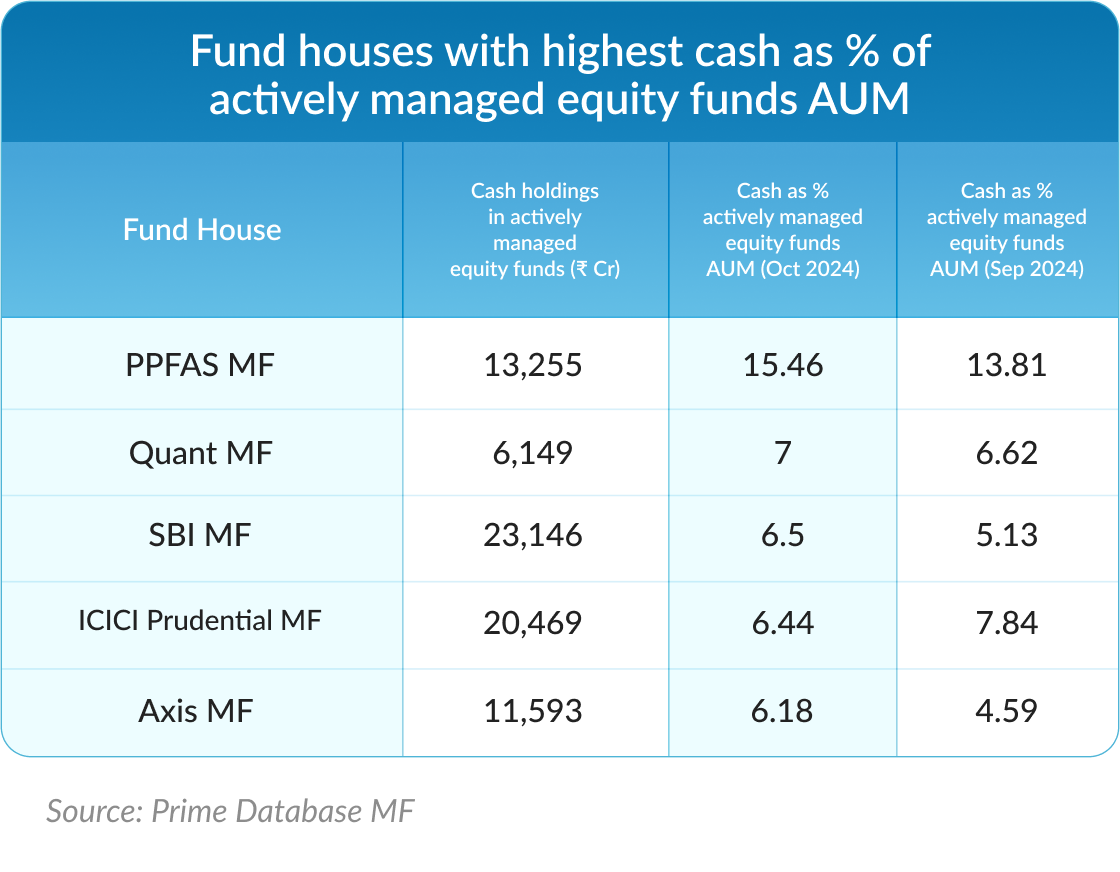
Here are the top funds with the highest and lowest cash as a percentage of their actively managed equity funds AUM (from publicly available data).
To Conclude
While it is not the only deciding factor of whether you should invest in a particular mutual fund scheme, you can consider this to review your schemes with their peers to optimize your assessment.
Leave a Reply